Chapter 40 — Labour Market Forces and Government Intervention
Cambridge International AS & A Level Economics (9708) · Unit 8.6 · 4th edition coursebook
Learning objectives
- Explain why the demand for labour is a derived demand.
- Define the meaning of marginal revenue product (MRP).
- Calculate the marginal revenue product of labour and use marginal revenue product to derive an individual firm's demand for labour.
- Analyse the factors affecting demand for labour in a firm or in an occupation.
- Analyse the causes of shifts in the demand curve and movements along the demand curve for labour in a firm or in an occupation.
- Analyse the factors affecting the supply of labour in a firm or in an occupation, including wage and non-wage factors.
- Analyse the causes of shifts in the supply curve and movements along the supply curve for labour in a firm or in an occupation.
- Analyse wage determination in perfect markets, including equilibrium wage rate and employment in a labour market.
- Evaluate wage determination in imperfect markets, including the influence of trade unions, government and monopsony employers.
- Explain the determinants of wage differentials by labour market forces.
- Define the meaning of transfer earnings and economic rent.
- Evaluate the factors that affect transfer earnings and economic rent in an occupation.
Key terms
- marginal revenue product
- The addition to total revenue as a result of employing one more worker.
- trade union
- An organisation of workers that aims to protect and enhance the well-being of its members through collective negotiations with employers and government.
- monopsony
- Where there is a single buyer in a market.
- wage differential
- Difference in pay between workers with different skills and responsibilities.
- transfer earnings
- The amount that is earned by a factor of production in its best alternative use.
- economic rent
- A payment made to a factor of production above that which is necessary to keep it in its current use.
40.1The demand for labour
Many of the principles of demand introduced in Unit 2 apply directly to the labour market, but there is one fundamental difference: the demand for labour is a derived demand. A firm demands labour because it has decided to produce certain goods or services, not for the sake of the labour itself. Clerks are employed because offices need them, streets need cleaning so cleaners are hired, young people need teaching so teachers are required, and firms need managers to meet corporate objectives. A small number of film stars, pop stars and sports personalities have exceptional talents — demand for their services is high and they command very large fees (see Figure 40.4).
The marginal revenue product of labour
A profit-maximising firm wants to know the value of what each extra worker produces. The marginal revenue product (MRP) of labour is the extra revenue earned by the firm when it employs one more worker. It is calculated as the marginal product of an additional worker multiplied by the price of the product. Assuming labour is the only variable factor and the firm sells at a fixed price, MRP first rises as additional workers raise marginal product, then falls steeply once the law of diminishing returns takes hold. There comes a point where an additional worker adds more to costs (the wage rate) than to revenue, and hiring stops.
The firm should therefore hire workers up to the point where MRP = wage rate. Beyond this, the value of the marginal product is less than the wage and the worker reduces the firm's profit. The MRP curve is therefore the firm's demand curve for labour: as long as the additional worker adds more to revenue than to the firm's costs, hiring continues.
Key concept link — The margin and decision-making
The profit maximisation position in the labour market MC = MRP is the same explanation as in the product market where MC = MR. Both are examples of decision-making at the margin.
Demand for labour in a firm or in an occupation
The demand for labour by a firm rests on two assumptions: the firm hires labour in a perfectly competitive market — many buyers and sellers, none of whom can affect the wage — and the firm is a profit maximiser. There are three main factors that determine demand for labour in a firm or occupation:
- Wage rate. A higher wage raises labour costs and reduces the quantity of labour demanded by the firm. This produces the downward-sloping demand curve for labour and a movement along it as the wage changes.
- Productivity. A change in the marginal productivity of labour shifts the demand curve. More productive workers raise output and so the value of MRP, making labour more attractive and shifting demand to the right; lower productivity shifts the curve left.
- Demand for the product. Because labour demand is derived demand, a rise in demand for the firm's product raises demand for labour (rightward shift), while a downturn reduces it (leftward shift).
A change in the wage produces a movement along the demand curve; a change in productivity or in the demand for the product shifts it. It follows that wages paid to workers should reflect their MRP — a teacher's MRP is higher than a clerk's, which is higher than a street cleaner's, and so on. The problem is that MRP is difficult to measure in many occupations: the marginal revenue product of a teacher, for example, can only be estimated with great difficulty. To explain wages fully we also need to look at the supply of labour.

The demand for labour is its marginal revenue product. An increase in the marginal productivity of labour (option C) raises MRP at every level of employment, shifting the labour demand curve to the right. Changes in the wage rate cause movements along the curve, not shifts in it.
40.2The supply of labour
The supply of labour is the total number of hours that labour is able and willing to work at a particular wage rate. The general principles of supply (Section 7.4) apply, but the labour market involves people and their willingness to participate. The decision usually depends on the wage rate offered, although for some workers the wage rate has only a minor influence and behavioural factors weigh more heavily (see Figures 40.5 and 40.7).
Labour supply can be considered at three levels: the individual worker, the firm or industry, and the economy as a whole. Different factors apply at each level.
The individual's supply of labour
For an individual, the wage is the main price signal in deciding whether to work. If the wage is too low, an individual may not bother to work, but most people need to work to live. The standard assumption is a positive relationship between wage and hours supplied: as the wage rises, more workers offer their services, giving an upward-sloping individual supply curve.
Beyond a certain point there is a trade-off between work and leisure. As the wage continues to rise, the worker may prefer more leisure to even more income, so the supply curve bends backwards. The exact location of this turning point depends on personal attitudes, the type of economy and the worker's family circumstances. The income tax rate also matters: tax in most countries is progressive, so low-wage workers pay little or no income tax while high earners pay much more. A very high marginal tax rate suppresses the incentive to work and can adversely affect future economic prospects.
Labour supply to a firm or industry
The supply curve of labour to a firm or industry is the sum of the individual supply curves of all workers employed in that firm or industry. It is usually upward-sloping throughout: more workers are willing to supply their labour as the wage rate rises. The slope is the elasticity of supply of labour, the extent to which labour supply responds to a wage change.
Different industries have different elasticities. The more skills required, the more inelastic the supply, because few workers have the necessary qualifications. The length of education and training needed also matters: teaching requires several years of study after school or college, while street cleaning requires very little, so the supply of teachers is more inelastic than the supply of street cleaners. In a competitive labour market the wage rates available in other industries also matter — an example is the gap between agricultural wages and wages in manufacturing or food processing, where manufacturers usually pay more.
The long-run supply of labour
The long-run supply of labour is particularly important for the economy as a whole. Several wider economic factors drive it:
- The size of the population. In high-income countries populations are often stable or increasing only modestly through immigration; in others they are actually declining, and with longer life expectancy a smaller share of the population is of working age. In low-income and lower middle-income countries, higher birth rates and improved medical care for children mean more young people joining the labour market, shifting the long-run supply curve right.
- The labour participation rate. This is the proportion of the working-age population actually in employment. Early retirement and more young people staying in higher education for longer both reduce participation. A fall in the participation rate shifts the long-run supply curve to the left.
- Tax and benefits levels. The work-leisure trade-off applies to the whole economy. Governments must be careful that taxation and benefits do not reduce people's willingness to work. Through supply-side policies, governments seek to keep particular types of labour active in the market.
- Immigration and emigration. Inflows of migrant workers fill labour shortages and shift the supply curve right; outflows shift it left.
For an individual firm, the long-run supply of labour also depends on the net advantages of a job — both monetary and non-monetary. Monetary advantages include the wage or salary itself, bonus payments, the chance to work longer hours and pension arrangements. Non-monetary advantages include hours of work, job security, holiday entitlement, promotion prospects, location, job satisfaction and the option to work from home. Rational workers consider both kinds of advantage before deciding whether to supply their labour; for many workers non-monetary advantages weigh heavily on occupational choice.
Key concept link — Time
The long-run supply of labour is essential for an economy's future economic growth. It depends on many factors, not all of which can be easily forecast by economists.
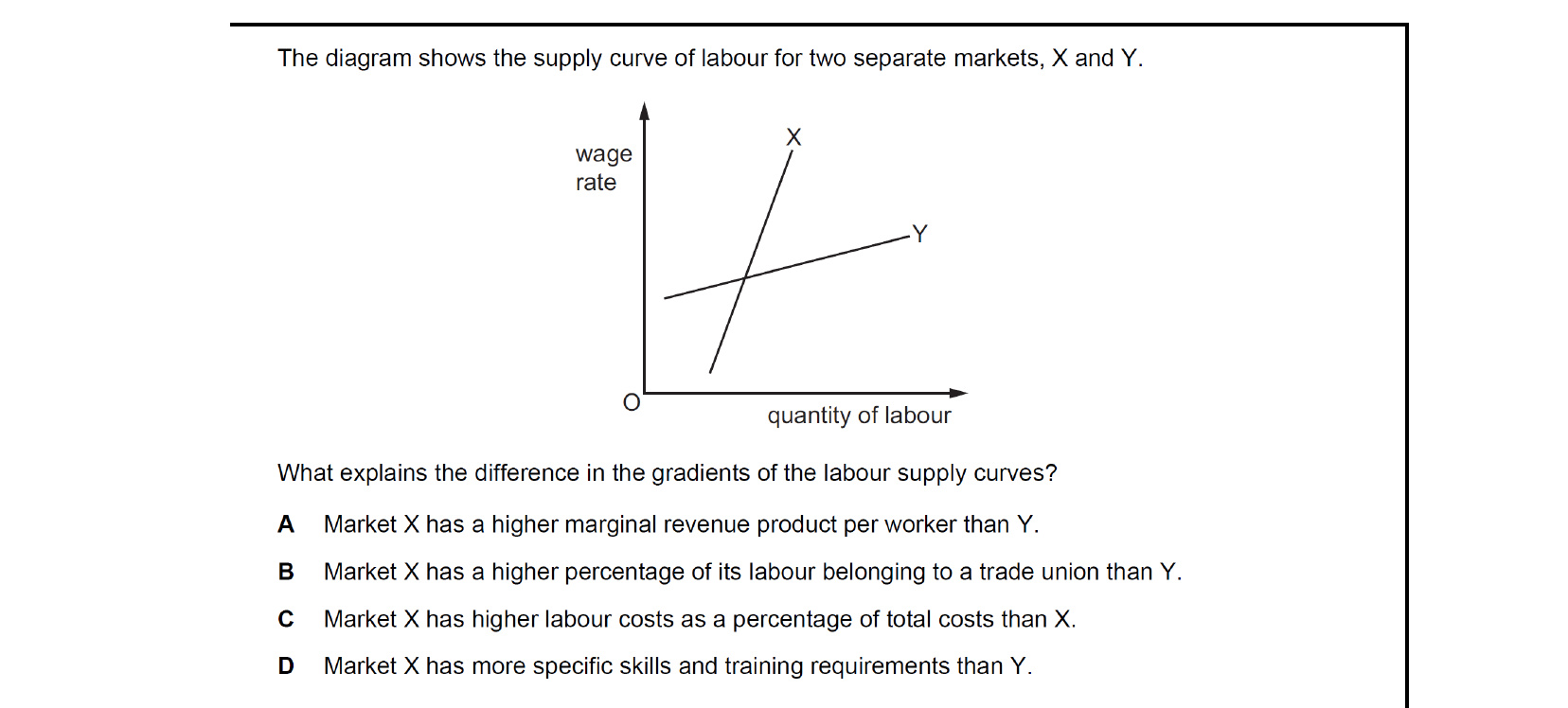
The elasticity (gradient) of labour supply depends on how easily new workers can move into the occupation. A market needing specific skills and training (option D) has a steeper, more inelastic supply curve because the pool of qualified workers is limited; markets with low skill requirements have flatter, more elastic supply.
40.3Wage determination in perfect markets
Two features of labour markets have now been established. First, the wage paid to labour equals the value of the marginal product of labour — the marginal revenue product. Second, the willingness of labour to supply its services to the labour market depends on the wage rate that is being offered. It might at first seem surprising that the wage can do both of these things at the same time, but this is due to how wages are determined in a competitive labour market (see Figures 40.8, 40.9 and 40.10).
The wage as a market-clearing price
The price of labour, the wage, is no different from any other price in so far as it depends on demand and supply. The demand curve reflects the value of the marginal productivity of labour and slopes downward; the supply curve reflects the wage required to attract workers into this market and slopes upward. Their intersection determines the equilibrium wage and the equilibrium level of employment. In equilibrium, workers receive the value of their contribution to the production of goods and services. Each firm purchases labour until the value of the marginal revenue product equals the wage rate. The wage paid in the market must therefore equal the value of the marginal revenue product of labour once demand and supply have been brought into balance, and the market clears at the equilibrium wage with no shortage or surplus of workers.
The labour market is dynamic
The labour market behaves like any other market: any change in the demand for, or the supply of, labour will change the equilibrium wage. The value of the marginal revenue product of labour also changes by the same amount, because by definition it must always equal the wage rate.
An increase in the demand for labour
Consider an industry such as clothing. A rise in the disposable income of consumers in high-income economies shifts the demand curve for clothing to the right, indicating that more clothing will be demanded at any price. Because the demand for labour is a derived demand, this in turn shifts the demand curve for clothing workers to the right. The equilibrium wage rises from its original level to a higher level, and the equilibrium quantity of labour employed also rises. The change in the wage rate reflects the change in the value of the marginal productivity of labour: with more clothing being sold at the same price, each additional worker generates more revenue, and the demand curve for labour (the MRP curve) lies further to the right.
An increase in the supply of labour
A change in the supply of labour also affects the market equilibrium. Suppose an inflow of migrant workers increases the number of workers able to produce clothing. The labour supply curve shifts to the right. The increased supply of labour exerts downward pressure on wages, which makes it more profitable for firms producing clothing to hire more labour. As the number of workers employed rises, the marginal productivity of labour falls (the law of diminishing returns), and so does the value of the marginal revenue product. The outcome is that wages are reduced for all workers in this market, although the level of employment rises. The new equilibrium again sits at the point where the wage equals the (now lower) value of the marginal revenue product.
In both cases, the model demonstrates an important feature of perfectly competitive labour markets: wages adjust automatically to changes in demand and supply, and at the new equilibrium the wage and the value of the marginal revenue product remain equal. There is no role here for trade unions, government or dominant employers — these influences belong to the analysis of imperfect labour markets that follows.
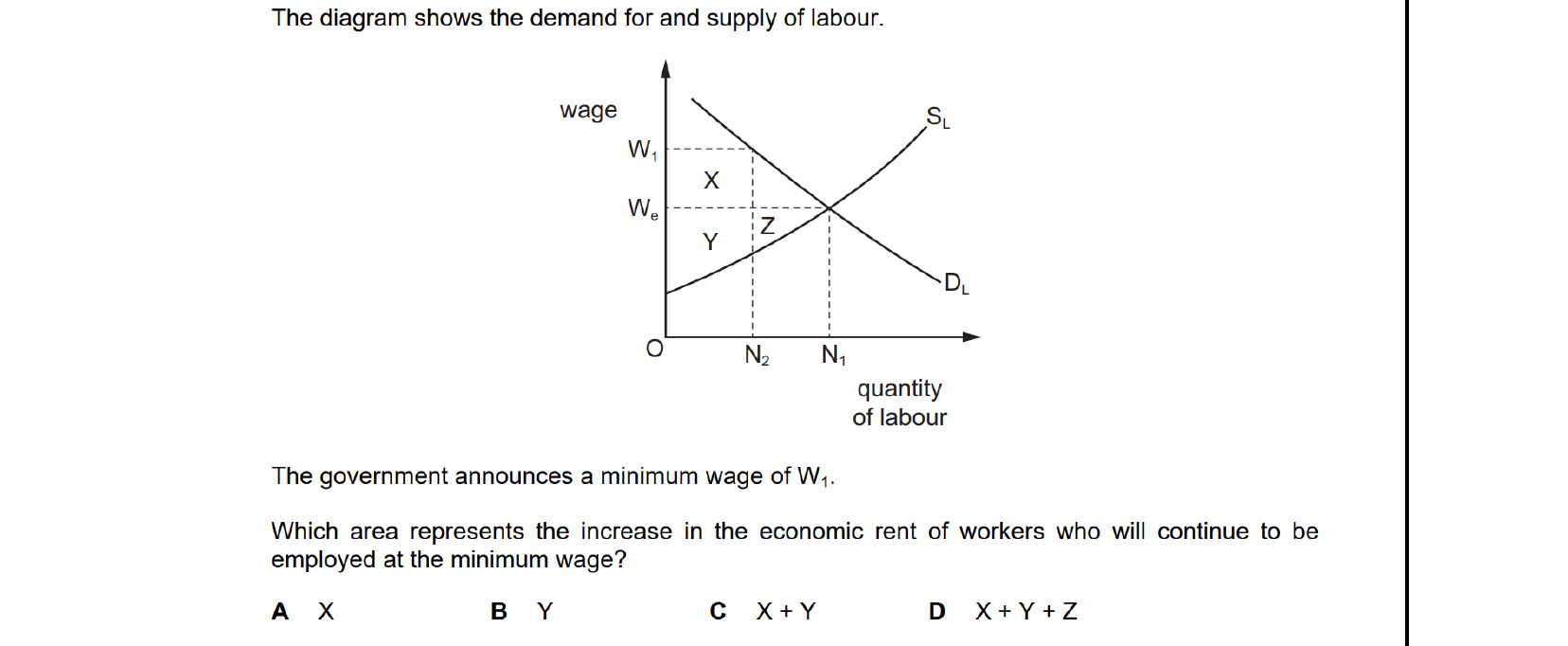
Economic rent for the workers still employed is the excess of their actual wage over the minimum (transfer earnings) they would have accepted. With the minimum wage W1 above equilibrium We, the gain to those still in work is the rectangle of extra wages above the original supply curve — area X (option A).
40.4Wage determination in imperfect markets
The competitive analysis assumes that demand and supply operate freely with no intervention. In many labour markets they are affected by trade unions, governments and monopsony employers, producing what are sometimes called imperfections (see Figures 40.12, 40.13 and 40.14).
Influence of trade unions on wage determination and employment
A trade union is an organisation of workers that aims to protect and enhance the well-being of its members through collective negotiations with employers and government. Individuals on their own have very little power to influence wages and working conditions. Through collective bargaining — union representatives meeting employers — unions aim to raise members' wages, improve working conditions, maintain pay differentials between skilled and unskilled workers, fight job losses, provide a safe working environment, secure additional working benefits, and prevent unfair dismissals. Unions have traditionally been strong in the public sector, most types of manufacturing, the transport industry and occupations requiring specialist skills; they are less important in services.
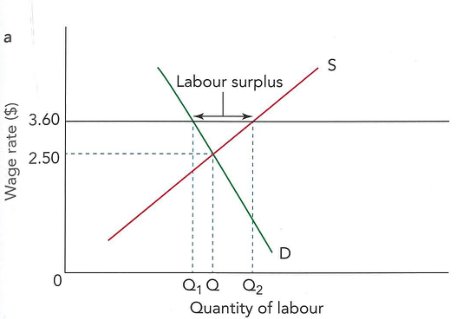
A powerful trade union in a competitive labour market can secure wages above the equilibrium wage. If the union forces wages up to a level above the competitive equilibrium, employers cut the quantity of jobs offered, but at this higher wage more workers would like to work. The result is a shortfall between those who want to work and those who actually have jobs. In practice it is difficult to prove whether this theory applies in real-world labour markets. A much-quoted example is that of actors in the UK and USA, where very strong unions restrict the numbers able to work in films, television and theatres, supposedly supporting members' wages.
Unions that push too hard play a dangerous game. High labour costs and restrictive practices can drive employers out of business or move production to countries with lower wage levels — a threat that has been particularly severe for some European and US car manufacturers, where production has been switched to lower-cost EU countries. In such circumstances unions have very little real influence.
Influence of government on wage determination and employment where there is a minimum wage
Governments intervene most explicitly via a minimum wage. The aim is to reduce poverty and the exploitation of workers with little or no bargaining power — particularly women in shops, small businesses and low-skill jobs such as cleaning and home working.
The case for a minimum wage is that state-benefit payments to low-income families fall and tax revenue may rise slightly. Critics argue that jobs are lost and that other low-paid workers seek pay rises to maintain their differential with the lowest paid, producing cost-push inflation. The effects depend on the elasticities of demand and supply for labour in the affected industry. When demand for labour is inelastic, the loss of jobs is small; when it is elastic, the loss is larger. In both cases there is excess supply of labour at the minimum wage, and the further the minimum wage is set above the competitive equilibrium, the larger the excess supply.
A national minimum wage may also fail to reflect variations in the cost of living within a country — costs of accommodation, food and other essentials are much higher in big cities. A 'living wage' has been promoted as a complement to the minimum wage. It is calculated on the basic cost of living but is paid by employers on a voluntary basis. The living wage is not the answer to poverty; it is part of a package of measures including a range of benefits that aim to improve the standing of those who are most vulnerable.
Influence of monopsony employers on wage determination and employment
A monopsony occurs when there is a single or dominant buyer of labour. The monopsonist can determine the wage paid to the workers it employs. It hires labour by equating the marginal cost of employing a worker with the marginal revenue product, which is the profit-maximising position. The wage paid is below what workers would receive in a competitive market — that is, below the value of their marginal revenue product — and employment is also lower than the competitive outcome.
Monopsonists often appear in local labour markets — a single major employer in a town or an extractive industry located well away from where workers normally live. The employer dominates the labour market and can dictate wages and other employment conditions.
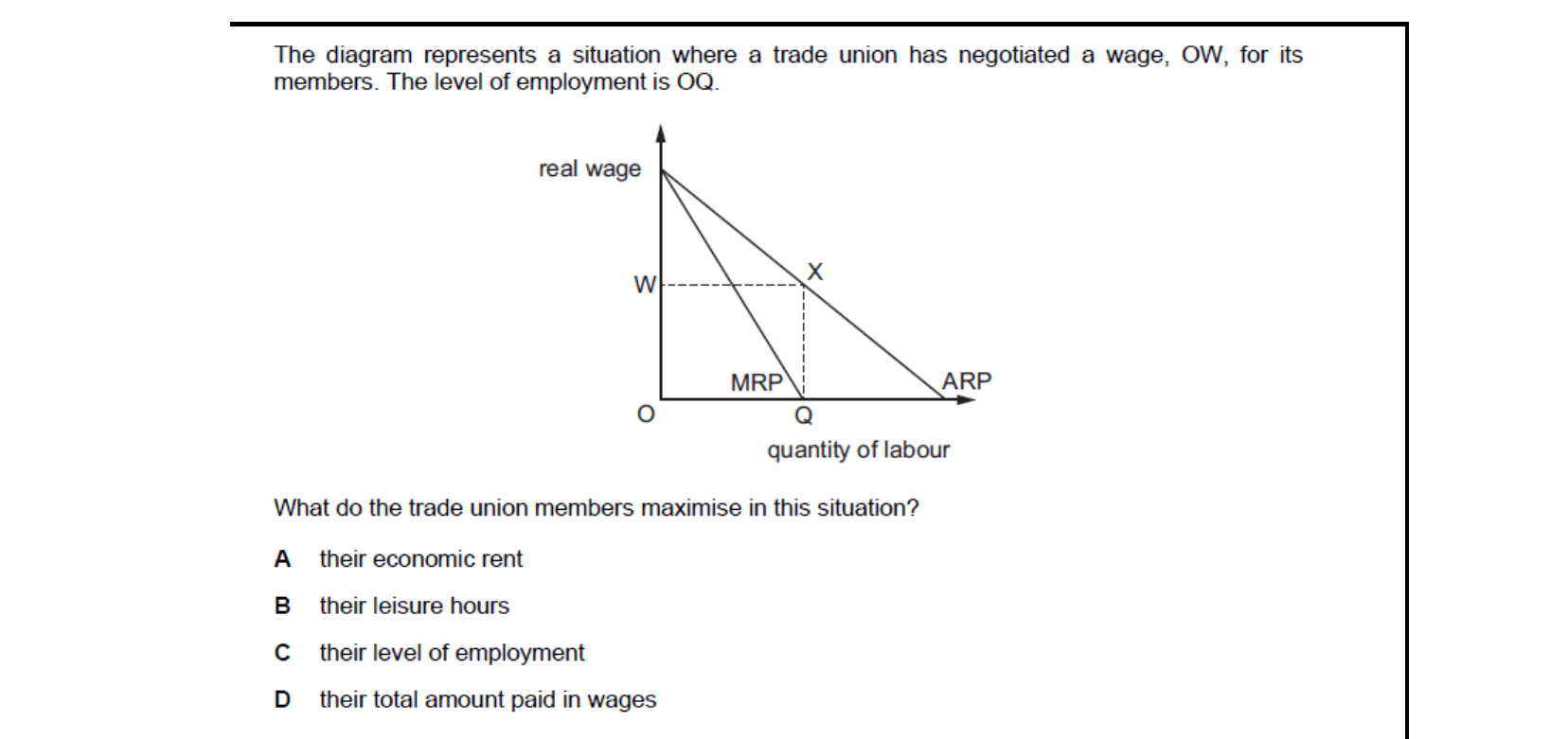
Under a horizontal union wage OW with employment OQ, total wages paid to members equal OW × OQ. If the union has chosen this combination, it is maximising the total wage bill of its members (option D) — not their economic rent, leisure hours or the number employed.
40.5Wage differentials
Wages clearly differ between occupations, between industries, between firms in the same industry and between regions of a country. An airline pilot earns more than a cabin attendant, who earns more than the worker who cleans the cabin after a flight. These differences can be partly explained by demand and supply: an occupation in high demand and low supply pays more than one with abundant supply.
Other causes of wage differentials include:
- Bargaining strength. Most airline pilots belong to a strong professional organisation or trade union, and any industrial action would have a substantial impact on an airline's revenue and future viability. Cabin attendants have some bargaining power; cleaners have little or none and can easily be replaced.
- Education and training. Healthcare, legal services and teaching require long periods of training, which is fairly reflected in the differential compared with occupations that do not.
- Skilled and unskilled workers. Skilled workers are paid more because demand for them is higher and their supply is lower, and because their MRP is higher (their skills raise output per worker). Skilled work is also harder to substitute with capital equipment than the repetitive work done by unskilled workers.
- Male and female workers. Despite equal pay legislation in many countries, men are still paid more than women in many occupations. A plausible explanation is that on average the MRP of women is lower because there are more women in low-paid occupations that generate low marginal revenue.
- Hours of work. Part-time workers on average earn lower wage rates than full-time workers because the pool of part-time workers in a local market is usually large. Many part-time workers are women.
- Government policy. Government policy indirectly shapes occupational choice. Shortages of healthcare workers in many high-income countries, often linked to ageing populations, prompt governments to recruit more doctors and nurses; the shortage widens the differential between these workers and others in similar occupations. A minimum wage can also reduce the differentials for the lowest-paid workers.
40.6Transfer earnings and economic rent
The question of why some people with exceptional talent are so highly paid can be answered partly the same way as the question of why a teacher earns more than a street cleaner — supply and demand. To make the analysis sharper, economists split earnings into two parts: (see Figure 40.15)
- Transfer earnings — the amount earned by a factor of production in its best alternative use; equivalently, the minimum payment necessary to keep labour in its present use.
- Economic rent — any payment to labour over and above transfer earnings.
Where the labour supply curve is upward-sloping, transfer earnings are shown by the area under the supply curve up to the chosen quantity of labour, while economic rent is the area above the supply curve and below the equilibrium wage. Workers willing to work for less than the equilibrium wage receive economic rent equal to the gap between what they were willing to accept and what they actually earn.
Different workers in the same job can have different mixes. Take bus drivers. Some are very willing to drive for a low wage — they have low transfer earnings and some economic rent. Others are attracted only by the equilibrium wage — for them the wage consists entirely of transfer earnings, with no economic rent.
Superstars can be explained by a perfectly inelastic labour supply curve. Their unique talent means their supply curve is vertical: earnings consist entirely of economic rent. In contrast, workers with a perfectly elastic supply — many unskilled workers and others in menial jobs — have no economic rent, since employers can hire as many of them as they like at the going wage. Earnings then consist entirely of transfer earnings.
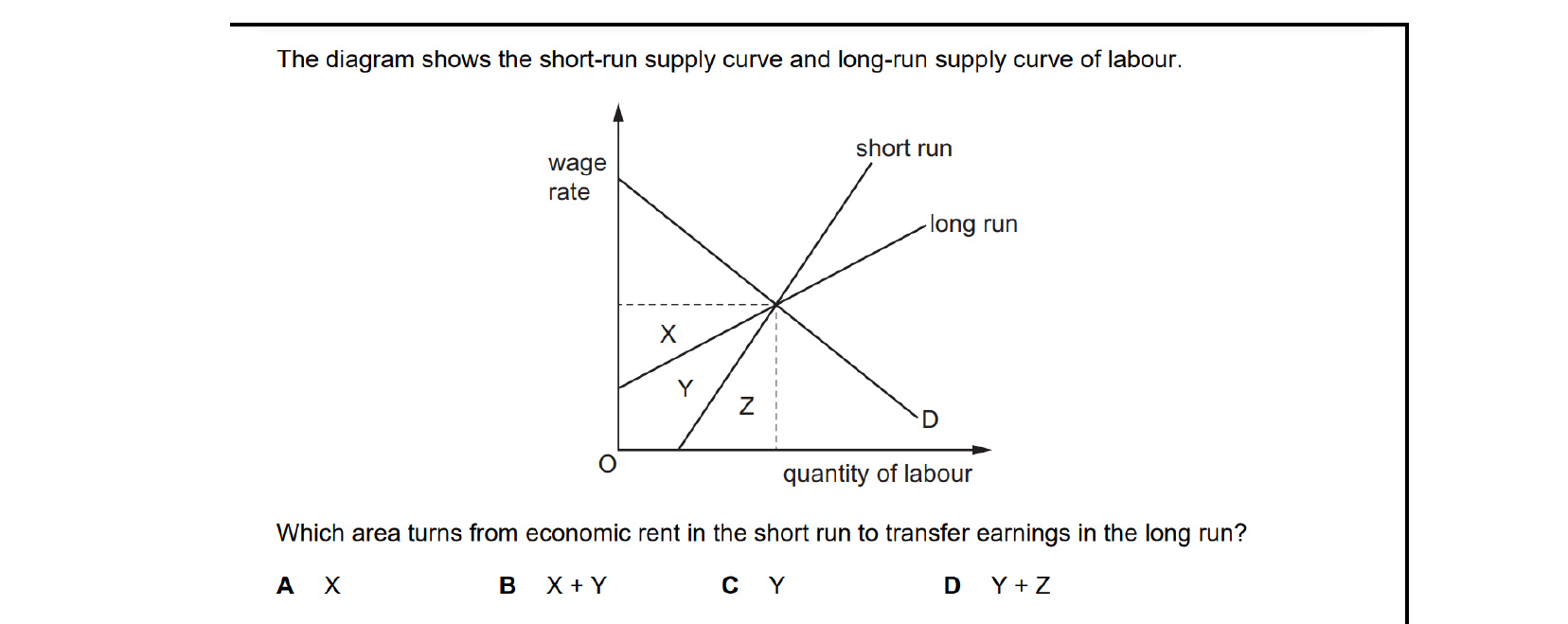
In the short run, labour supply is steep (inelastic), so a large part of earnings is economic rent. In the long run, supply becomes more elastic as workers can switch occupations, so what was rent now needs to be paid to keep workers in the job — it becomes transfer earnings. The area that changes status is Y (option C).
End-of-chapter practice
Past-paper questions from CIE 9708. Pick A, B, C or D. Answers are saved on this device — press Download report (PDF) at the top to save them.
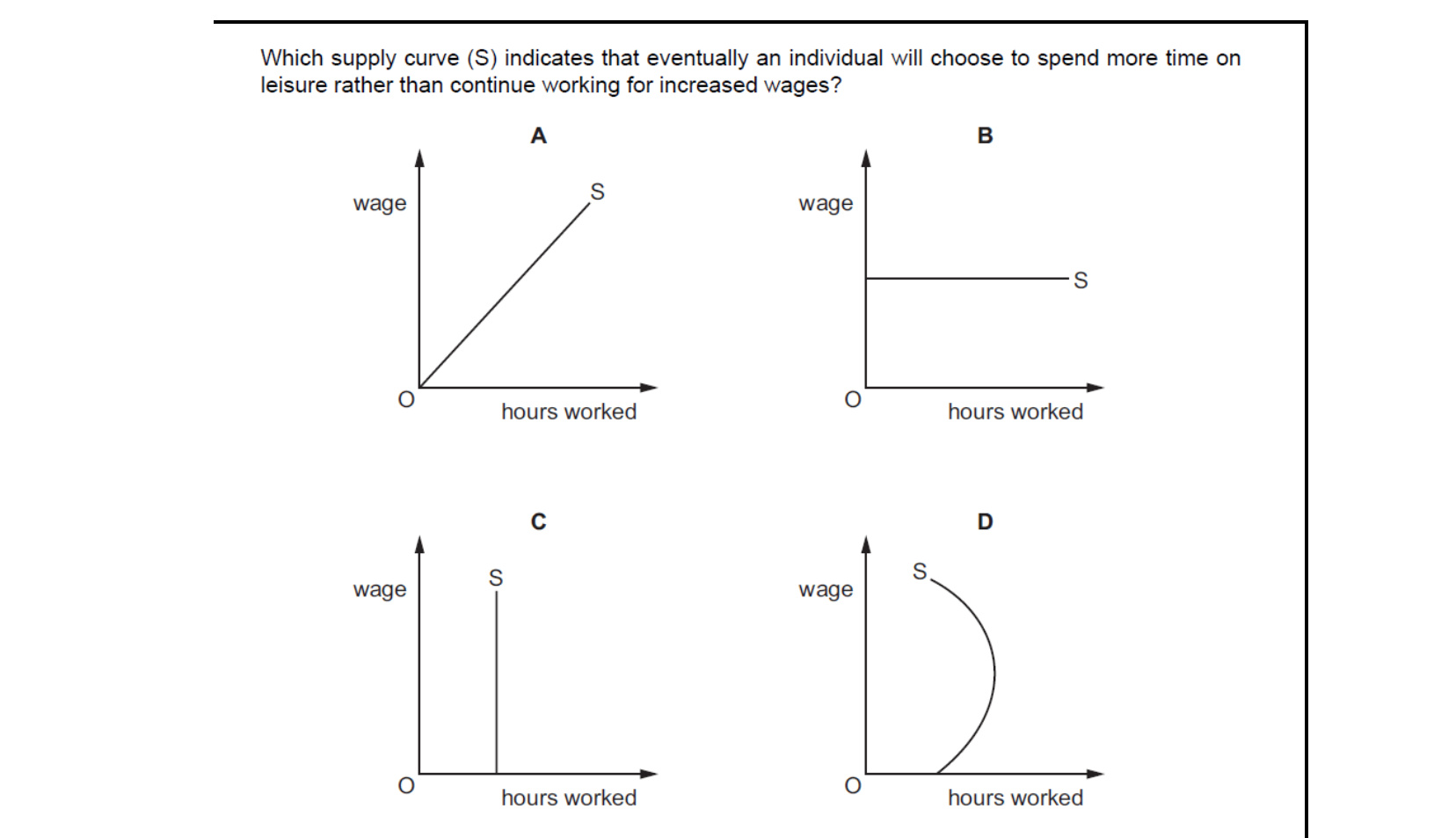
As wages rise the substitution effect encourages more hours, but at very high wages the income effect dominates and workers choose leisure over extra work — supply bends backwards. The diagram showing a supply curve that initially slopes up and then bends back to the left (option D) captures this.

Transfer earnings are the minimum payment required to keep a factor in its present use. For the factor 'enterprise', this minimum is the normal profit needed to stop the entrepreneur leaving the industry. Anything above this is economic rent (supernormal profit). The transfer earnings of enterprise are therefore normal profit (option B).
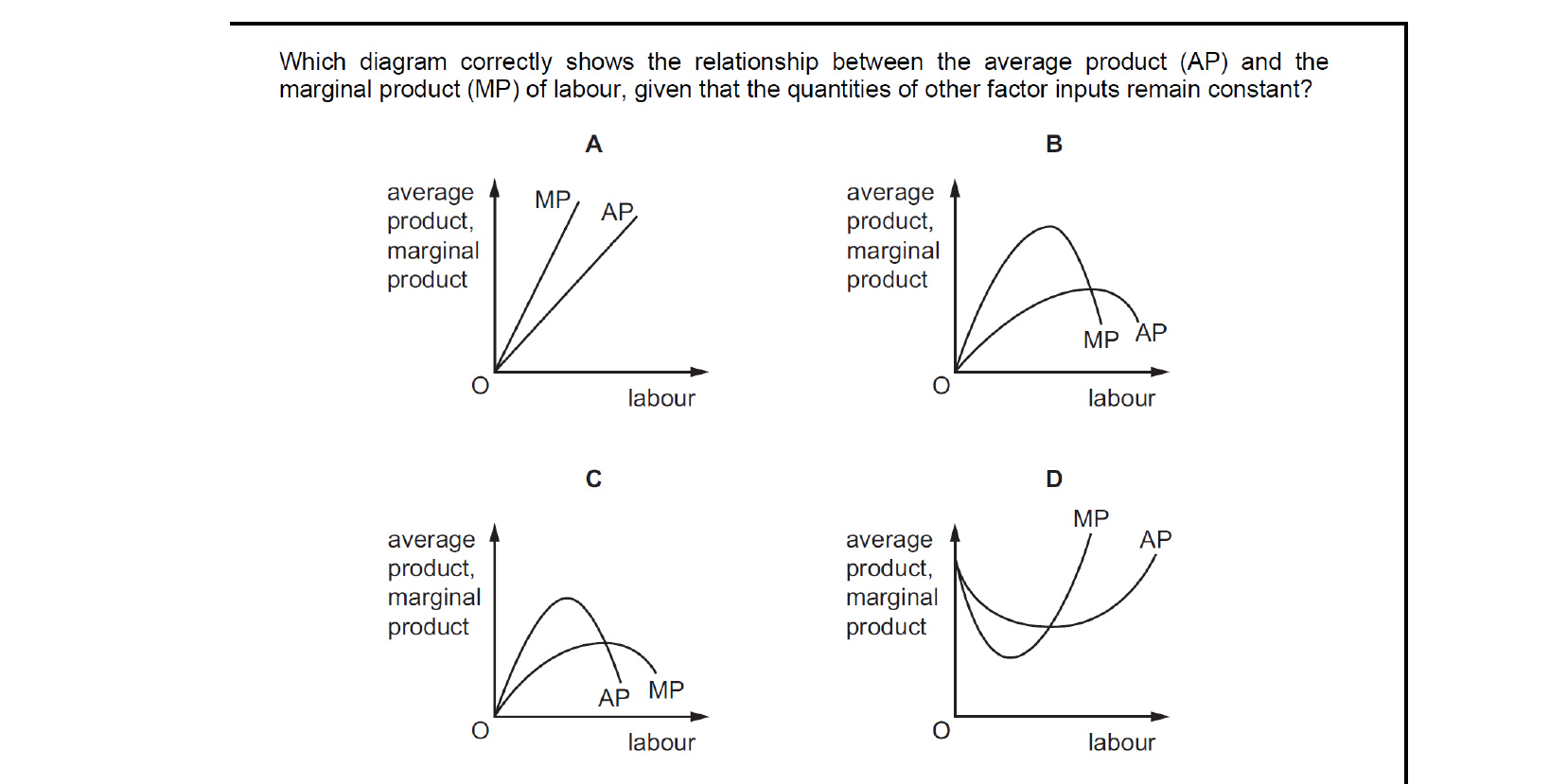
When other inputs are fixed, both MP and AP first rise then fall, and the MP curve cuts the AP curve at the peak of AP — this is a standard result from the law of variable proportions. The diagram showing MP rising above and then crossing AP from above at AP's maximum (option B) depicts this relationship.
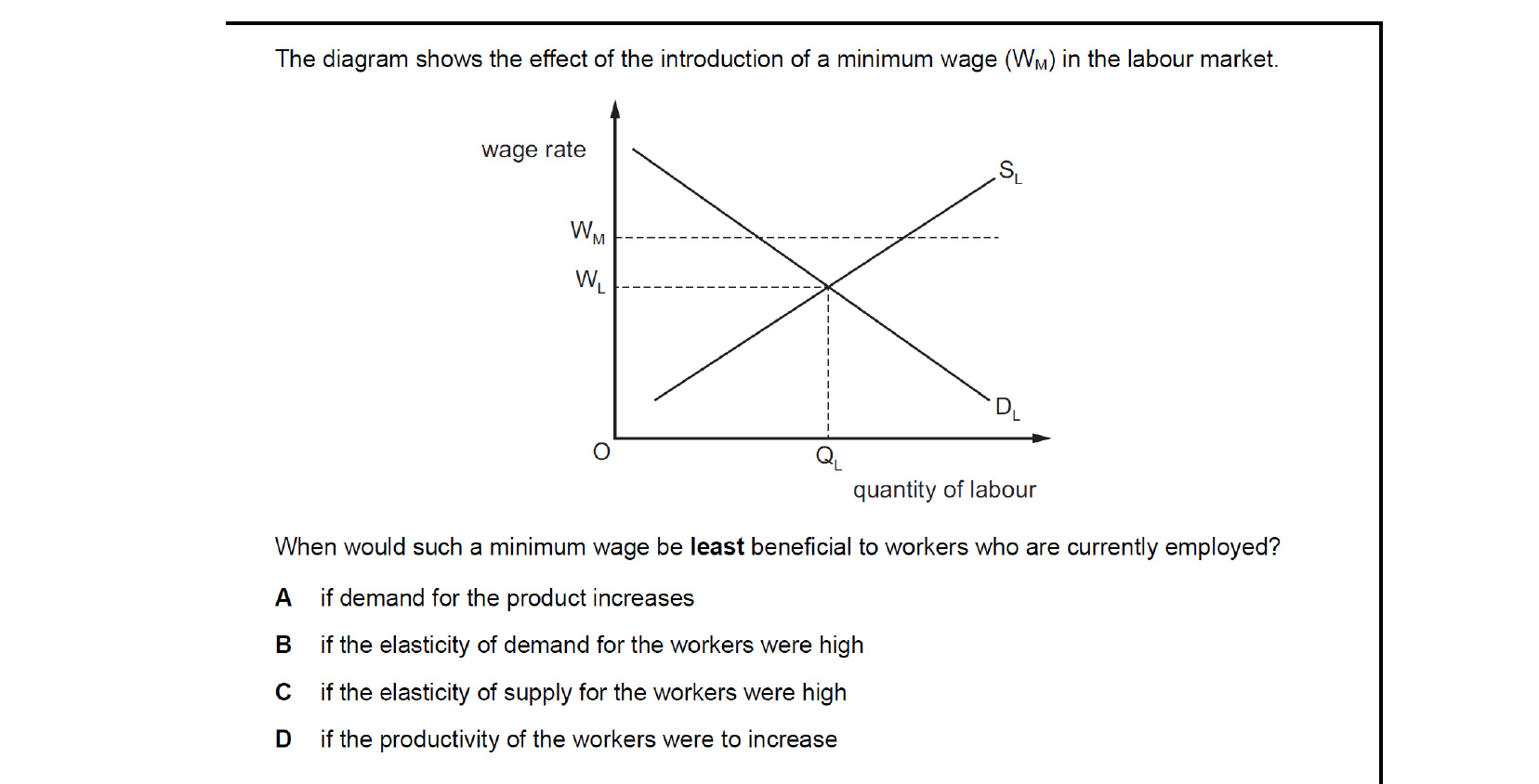
A minimum wage above the market rate causes unemployment when employers cut hiring. The job losses are greatest when the demand for labour is elastic, because employment responds strongly to the wage rise. Workers gain least overall when elasticity of demand for labour is high (option B).
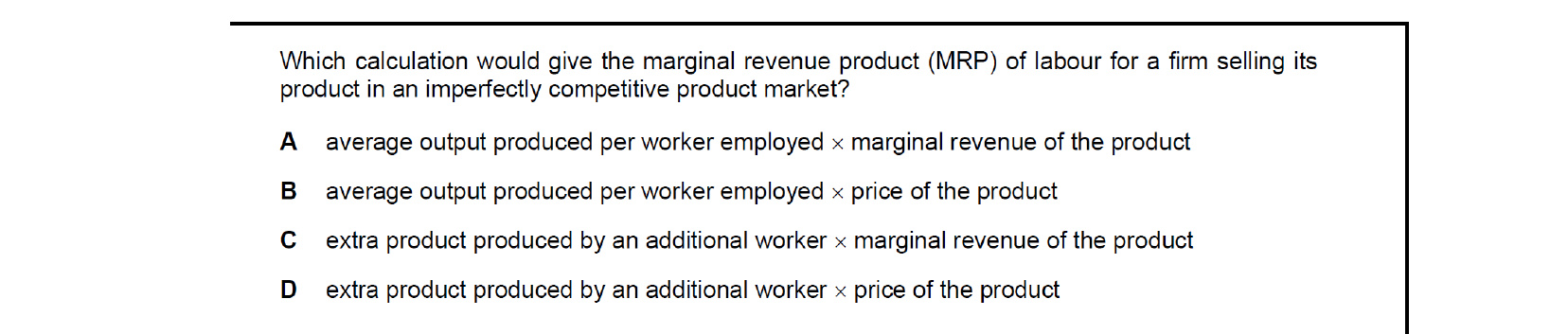
MRP = MP of labour × marginal revenue of the product. In an imperfectly competitive product market, price exceeds MR, so MR (not price) must be used. Option C — extra product produced by an additional worker × marginal revenue — gives the correct expression.
Attempt the practice questions above to build your score.
Self-evaluation checklist
After studying this chapter, you should be able to:
- Explain why the demand for labour is a derived demand.
- Understand that the marginal revenue product of labour (MRP) is the extra revenue earned by the firm when it employs one more worker.
- Calculate the MRP of a firm and use MRP to derive a firm's demand for labour.
- Analyse the factors affecting the demand for labour in a firm or occupation: wage rate, productivity, demand for product.
- Analyse the causes of shifts in the demand curve and movements along the demand curve for labour in a firm or in an occupation.
- Analyse the factors affecting the supply of labour in a firm or occupation: wage rate and other non-monetary factors.
- Analyse the causes of shifts in the supply curve and movements along the supply curve for labour in a firm or in an occupation.
- Analyse wage determination in perfect markets: equilibrium wage rate, employment in a labour market.
- Analyse the influence of trade unions, government and monopsony employers on wage determination and employment in imperfect markets.
- Define the meaning of transfer earnings and economic rent.
- Evaluate the factors that influence transfer earnings and economic rent in an occupation.
Want more practice? Drill this chapter's past-paper MCQs (149 questions) →